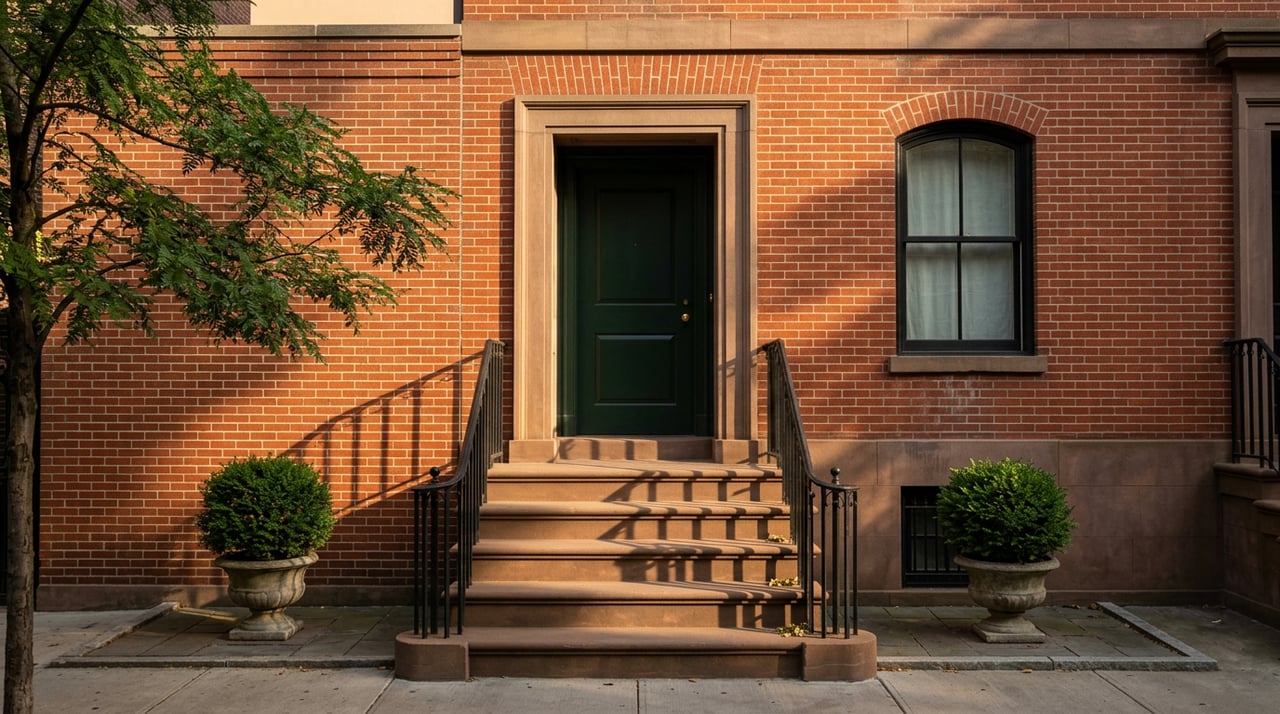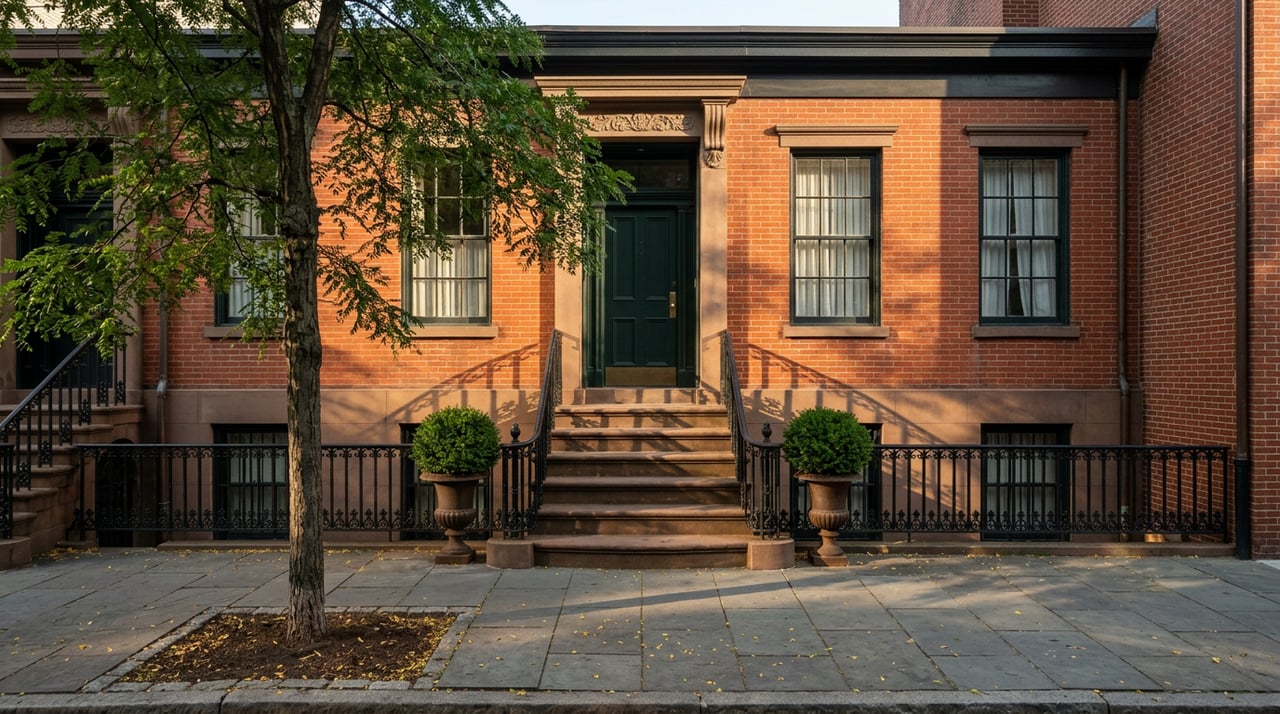
A buyer touring a prewar co-op near Washington Square this summer got two numbers in the same afternoon. The listing agent quoted a maintenance figure that included a line item for an upcoming Local Law 97 retrofit assessment. Later that day, a call about a unit at a new tower going up on West 13th Street quoted a starting price of $4.5 million and no such line item at all, because the building doesn't exist yet and was designed to meet emissions caps from day one.
Both of those apartments are in Greenwich Village. Neither one looks anything like the neighborhood's headline price statistics this year, and that gap is the actual story. If you've been comparing Greenwich Village to other Manhattan neighborhoods using the numbers making the rounds lately, you've been comparing yourself to a market almost nobody buys into.
What the Numbers Are Actually Counting
PropertyShark's neighborhood data for April 2026 put the median Greenwich Village condo sale price at $11 million, up 480.5 percent year over year. The median house price came in at $21.5 million, up 117.2 percent. Redfin's rolling three-month window through May 2026 showed the median sale price at $1.8 million, up 24.3 percent, with price per square foot at $2,870, up 115.6 percent.
Numbers like that would normally signal a neighborhood in the middle of a buying frenzy. But Greenwich Village isn't a high-volume market. Redfin counted 81 total home sales across the entire neighborhood in May 2026. When a market that small includes even one closing at $10 million or more, the median doesn't just move, it lurches. A single sale can outweigh dozens of ordinary transactions.
Compare that to the market's actual center of gravity. A Greenwich Village-focused market report covering activity through early summer 2026 recorded 29 closed sales in a 30-day period at a median close price of $1.44 million, with active inventory sitting at a median ask of $1.50 million, or $1,704 per square foot. That same snapshot found co-ops made up 64 percent of active inventory. Separately, Homes.com listed 149 co-ops for sale in the neighborhood, with a 12-month median sale price of $1,350,000, actually down 8 percent from the prior year.
Put those two data sets side by side and the picture is unmistakable. The number getting quoted around town describes a handful of extraordinary closings. The number that describes what most people actually pay is roughly a tenth of that, and it isn't rising nearly as fast.
| What's being measured | Reported figure | Time window |
|---|---|---|
| Condo median (PropertyShark) | $11.0M, up 480.5% YoY | April 2026 |
| House median (PropertyShark) | $21.5M, up 117.2% YoY | April 2026 |
| Co-op median (PropertyShark) | $1.2M, up 15.6% YoY | April 2026 |
| Rolling 3-month median (Redfin) | $1.8M, up 24.3% YoY | 3 mo. ending May 2026 |
| Typical closed sale (30-day snapshot) | $1.44M median close | Early summer 2026 |
| 12-month co-op median (Homes.com) | $1,350,000, down 8% YoY | 12 mo. trailing |
The co-op line is the one that tracks with what's actually changing hands. Everything above it is being pulled by a small number of very large transactions.
The Three Buildings Doing the Pulling
Greenwich Village hasn't seen a new residential tower in decades, which is exactly why the ones arriving now carry so much weight in a thin data set.
The most visible is The Greenwich Spire, rising at 11 West 13th Street just off Fifth Avenue. At 538 feet, it will become the tallest building in the neighborhood by roughly 200 feet, a fact that has already drawn a zoning challenge from preservationist groups even as construction financing of $191.1 million closed in February 2026. The tower, designed by Kohn Pedersen Fox with interiors by Leroy Street Studio, will hold just 34 residences averaging 3,020 square feet each, with pricing starting around $4.5 million. Sales are expected to launch later in 2026 through Corcoran Sunshine Marketing Group, with completion targeted for mid-2028.
Down the block, The Village West at 525 Sixth Avenue already ran its full course. The 68-unit building, developed by Izaki Group and designed by BKSK Architects, launched sales in September 2025 with units priced from $1.4 million to $6.5 million and a penthouse listed at $11.25 million. It sold out in under a year. A smaller project at 44 West 8th Street is bringing just five residences to the neighborhood, a boutique release that barely registers as inventory but still counts as a condo sale when it closes.
None of these buildings represent volume. Together they represent maybe a hundred transactions spread across two to three years. But because Greenwich Village's overall transaction count is so low, closings from these three buildings alone are enough to bend the median far past where the broader market is actually trading.
Why the Old Buildings Are Playing a Different Game
The other half of this story is what's happening inside the buildings that aren't new. Local Law 97, the city's building emissions law, set its first compliance deadline for calendar year 2024 emissions, with filings due March 31, 2026, and the final penalty assessment date for that first cycle falling on May 1, 2026. Both dates have now passed, and buildings that came in over their emissions cap are facing a fine of $268 per metric ton of carbon dioxide equivalent every year they remain over, with late filing penalties running up to $0.50 per square foot per month.
Prewar co-ops are the buildings most exposed to this. Habitat Magazine's coverage of the neighborhood has documented The Brevoort co-op replacing its gas-powered dryers with electric models to meet emissions requirements, and Waverly Mews installing variable refrigerant flow heat recovery units that are projected to cut winter heating bills by 80 percent while bringing the building into compliance. Neither retrofit is cheap, and neither is optional if the building wants to avoid an annual fine that compounds every year it's ignored.
For a buyer, that means the maintenance number on a Greenwich Village co-op listing isn't just covering staff and heat anymore. It's increasingly covering a capital plan tied to a filing deadline that just passed and a second, tighter emissions cap arriving in 2030. New condos like Greenwich Spire were designed to current code from the start and don't carry that exposure. It's a real cost difference between the two markets, not just a stylistic one, and it's worth asking about directly:
- Has the building filed its 2024 emissions report, and was it under or over the cap?
- If over, is there a retrofit plan in place, or is the board currently paying the annual fine?
- Has a capital assessment been discussed with shareholders, and is it reflected in current maintenance figures?
- Which compliance pathway does the building fall under, standard emissions cap or the alternate track for buildings with a high share of rent-regulated units?
What This Means If You're Comparing Neighborhoods
If you're shopping Greenwich Village against the West Village or the East Village using price per square foot, a neighborhood pricing analysis updated in May 2026 put the range that actually applies to most Village listings at roughly $1,800 to $2,400 per square foot for condos, positioning it below the West Village's $2,200 to $3,000 range and above the East Village's $1,400 to $1,800. That's a useful number. The $2,870 per square foot figure circulating from recent three-month data is not wrong, it's just describing a market segment most buyers aren't shopping in.
The practical takeaway is to ask which Greenwich Village you're actually being quoted. A $4.5 million unit at a brand-new tower and a $1.2 million prewar co-op three blocks away are both accurately described as Greenwich Village real estate, and they have almost nothing else in common, from board approval timelines to what's baked into the monthly carrying cost.
A Couple of Questions Worth Settling Upfront
Does the reported median mean typical Village apartments now cost millions more than last year? No. The co-op segment, where most transactions actually happen, was up a comparatively modest 15.6 percent year over year as of April 2026, and the trailing 12-month co-op median was actually down 8 percent. The eye-catching jumps are concentrated in the small condo and townhouse segments, where a handful of large closings carry outsized weight.
Does Local Law 97 affect condo owners too, or just co-ops? It applies to any covered building over 25,000 square feet regardless of ownership structure. New condos like Greenwich Spire are built to comply from day one, so the exposure is lower. Older condo buildings can face the same retrofit and filing pressure as co-ops if their systems predate current emissions standards.
If you're weighing a prewar co-op against a new-construction condo in Greenwich Village, the honest comparison has to include what's ahead for each building, not just what's listed on the door. Miller Schackman works through those numbers building by building, and if you're wondering how a Local Law 97 filing or a retrofit plan might affect what your own apartment is worth, get your free home valuation and we'll walk you through it.